
Tattoo Flash Art Project · Lift Trucks Art
Ashton Taylor
Dates Unknown · England
Life & Work
The Dragon of Ashton Taylor
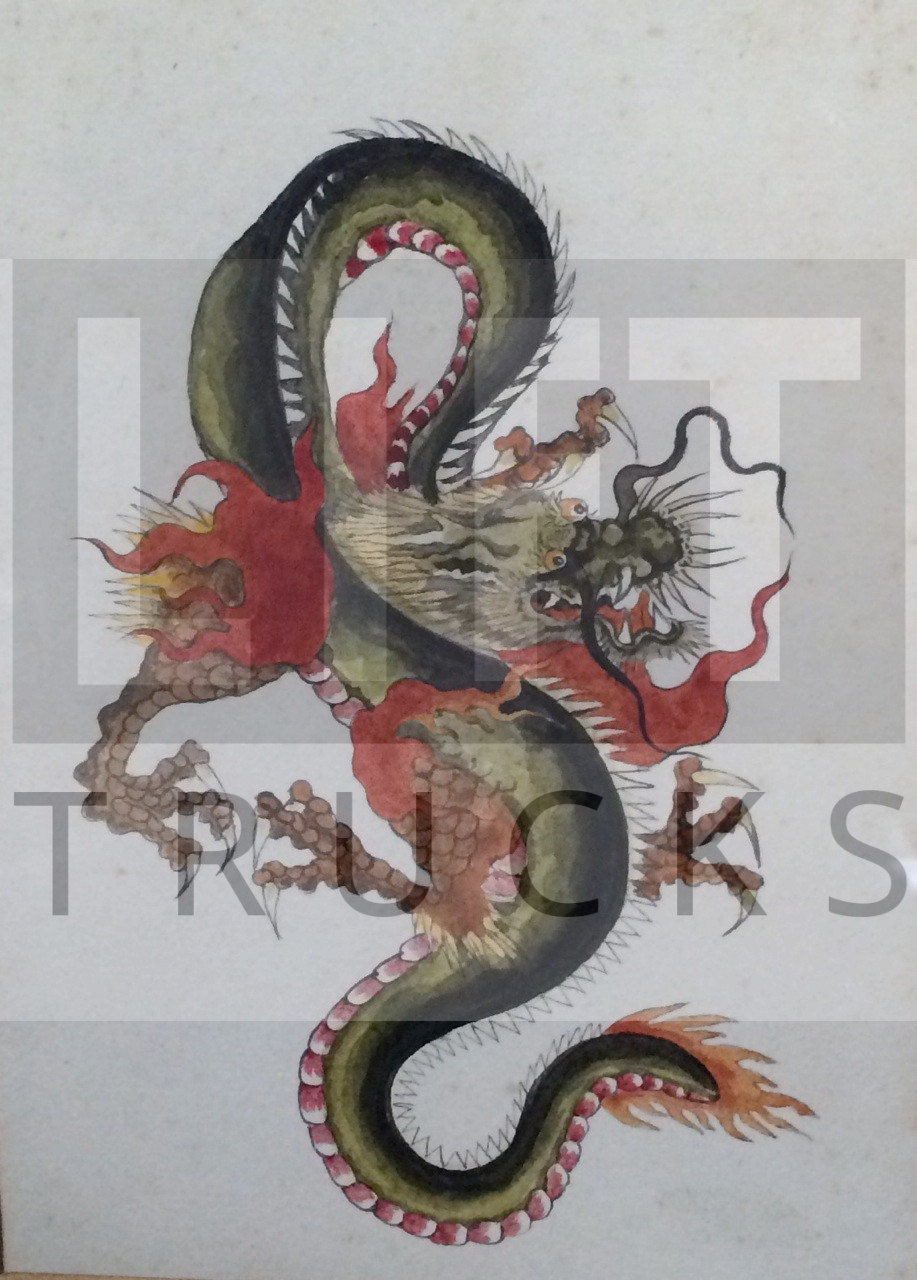
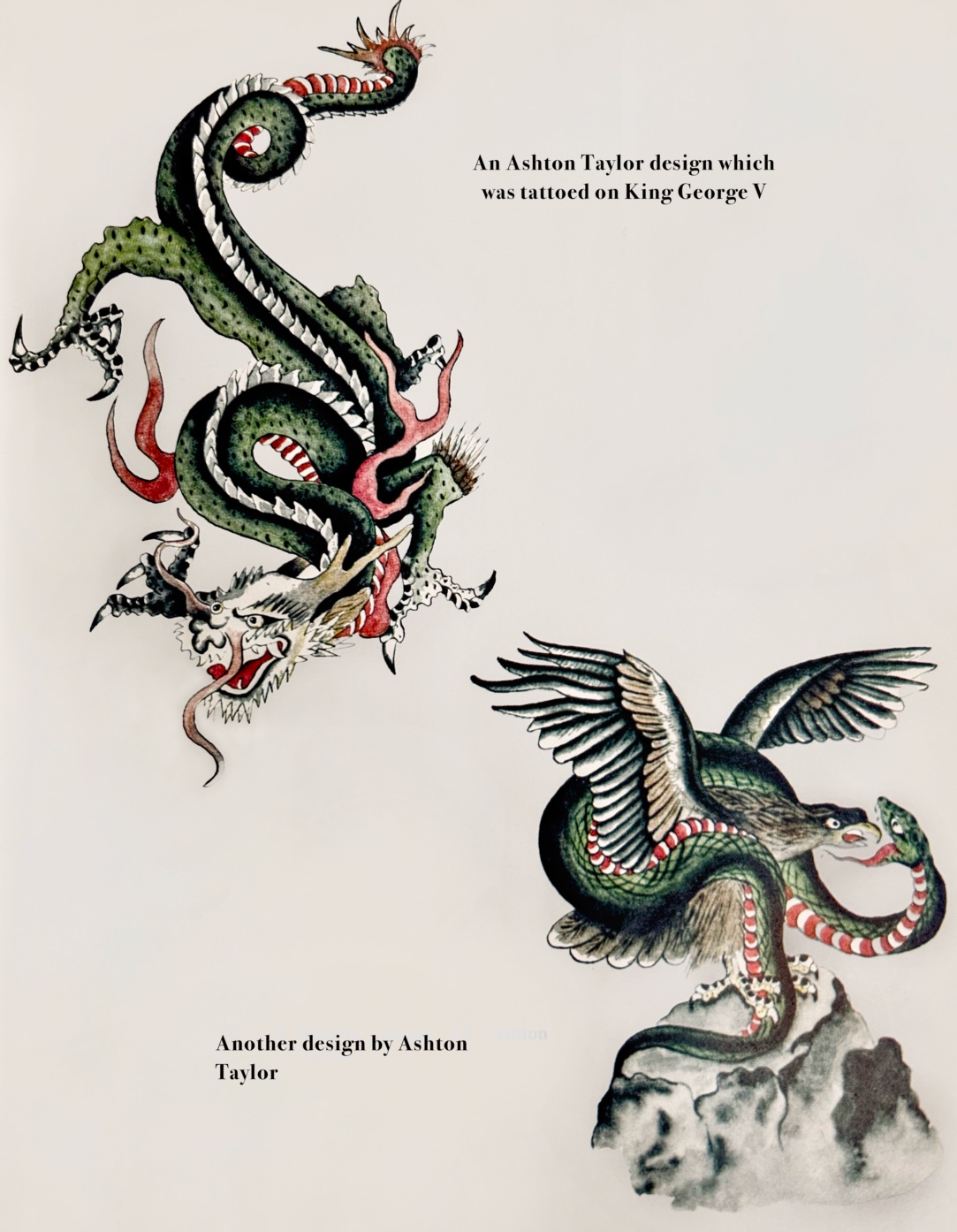
This powerful dragon drawing has been attributed to the British tattoo artist Ashton Taylor. Very little documentation survives about Taylor himself, which is not unusual in early tattoo history. Many working tattooers of the late nineteenth and early twentieth centuries left behind images rather than biographies. What remains instead are the drawings—and occasionally the stories attached to them.
The attribution comes through the late Paul of the Rambo Tattoo Museum in the UK, who acquired the sheet from tattoo historian and author Chris Wroblewski. According to that chain of custody, the drawing was one of several loose sheets preserved in an old tattoo sketchbook associated with Ashton Taylor. It remained on display in the museum for roughly two decades before entering the Lift Trucks collection.
Whether or not Taylor can be confirmed with certainty as the maker, the drawing itself belongs unmistakably to the vocabulary of early British tattoo flash. The dragon shows confident contour control, balanced body rhythm, and a structure designed for translation to skin rather than paper display. It is working imagery—meant to move.
British tattoo artists played a decisive role in shaping what would become American traditional tattooing. As Albert Parry observed in Tattoo: Secrets of a Strange Art, American tattoo imagery frequently followed British precedents because the artists, the motifs, and the technical traditions themselves crossed the Atlantic together. Sailors carried designs. Tattooers carried sketchbooks. Shops carried influence.
Many of these artists trained in environments where academic drawing and museum study were still part of visual culture. London’s Victoria and Albert Museum and the Natural History Museum provided access to ornamental pattern, animal anatomy, ethnographic objects, and Japanese decorative arts—sources that fed directly into tattoo flash design during the late nineteenth and early twentieth centuries. Dragons in particular reflect that exchange, combining European heraldic structure with Japanese compositional movement.
A photograph discovered inside the frame when this drawing surfaced was once thought to depict Ashton Taylor himself. The evidence suggests otherwise. Early tattoo artists rarely left formal portrait documentation, and the sitter appears more consistent with a contemporary studio patron than a working tradesman tattooer of the period. The image remains an artifact of the drawing’s history, but not likely its author.
Attribution aside, the drawing stands as a strong example of early British dragon tattoo design at the moment when transatlantic tattoo culture was forming its shared visual language. Even without a confirmed biography, Ashton Taylor’s name survives attached to a sheet that clearly belongs to that tradition.
Born / Died
Unknown
Location
Somewhere in England
Known For
Associated with attributed dragon flash
Flash Art · Original Works
Original Flash Sheets
Tattoo Flash Art Project
Explore the Full Archive
Original tattoo flash art collection from over two dozen artists who built American tattooing. Explore the online archive.